


Who Is Gwendoline Christie?
Gwendoline Christie is an English actress known for her work across television, film and theatre. She was born on 28 October 1978 in Worthing, West Sussex, England.
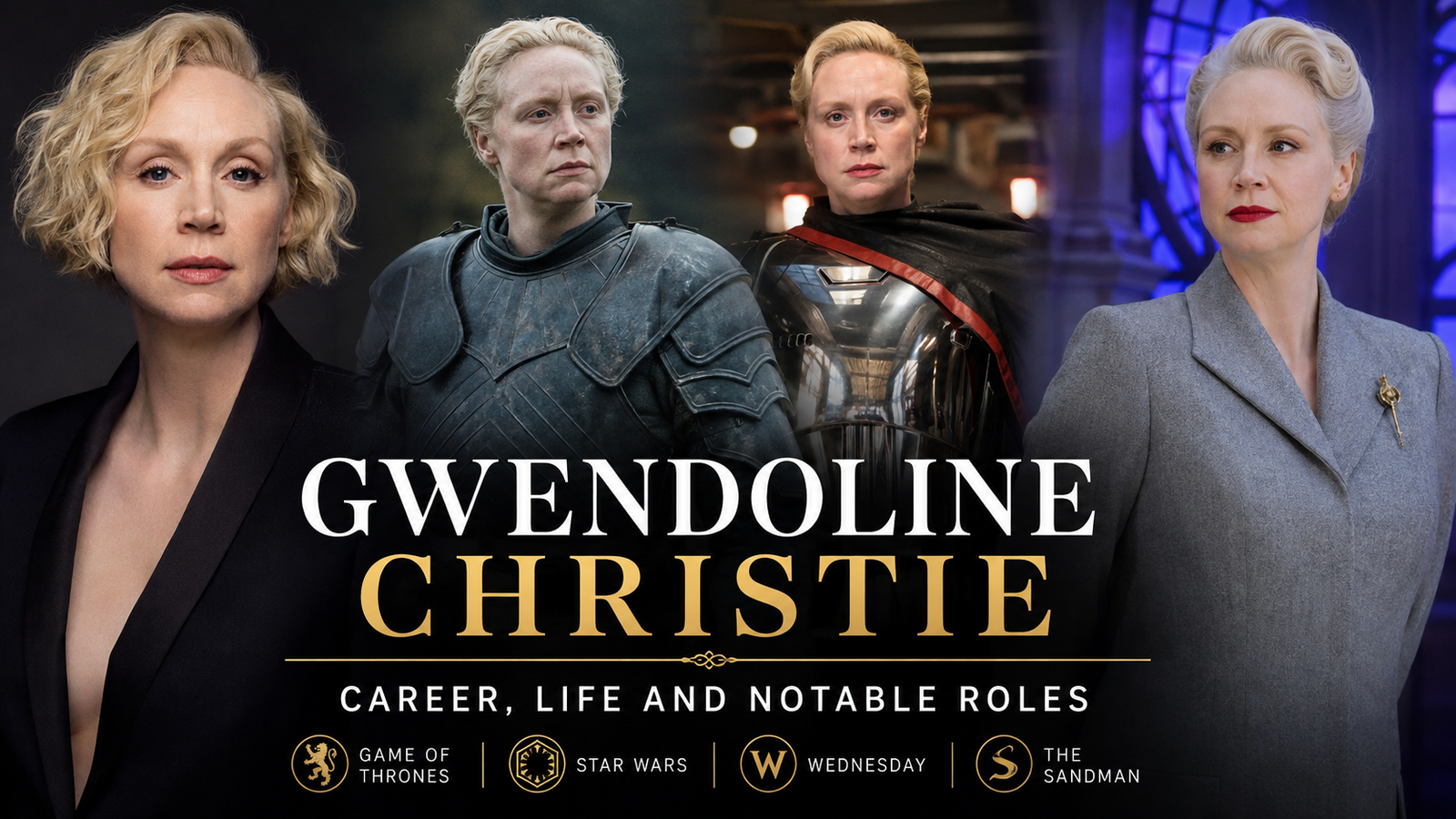
Christie became a household name after being cast as Brienne of Tarth in HBO’s Game of Thrones. The role transformed her career and earned widespread recognition for a character who challenged traditional ideas about strength, femininity and heroism.
Her career has since expanded into productions such as:
- Star Wars: The Force Awakens
- Star Wars: The Last Jedi
- Top of the Lake: China Girl
- The Darkest Minds
- The Personal History of David Copperfield
- Wednesday
- The Sandman
- Severance
Her ability to move between fantasy, drama, comedy and theatrical productions has helped establish her as one of Britain’s distinctive contemporary performers.
Early Life and Education
Gwendoline Christie grew up in Sussex. Before becoming an actress, she experienced a period of uncertainty about what direction her life would take.
Her height and physical appearance made her stand out from an early age. While these characteristics eventually became valuable assets in performance, Christie has discussed the complicated relationship she had with her body and appearance while growing up.
She eventually discovered acting and developed an interest in performance. That interest led her towards professional training at the Drama Centre London.
Training at Drama Centre London
Christie studied at the Drama Centre London, an institution known for its demanding approach to actor training.
Drama training gave her an opportunity to develop more than technical acting skills. It also helped her explore movement, voice, character development and the psychological aspects of performance.
This foundation became particularly valuable when she later took roles requiring physical transformation and strong stage presence.
How Did Gwendoline Christie Start Acting?
Christie’s professional acting career developed through theatre before she became widely recognised on television.
Early stage work allowed her to build experience without relying solely on the characteristics that later made her visually distinctive on screen.
She appeared in theatrical productions including Shakespearean works and other challenging dramatic material. Theatre provided a useful environment for developing discipline because actors must sustain a performance in real time without the ability to rely on multiple takes.
Her early career demonstrates an important point about acting: major recognition can come years after an actor begins professional work.
Gwendoline Christie and Game of Thrones
For many viewers, Gwendoline Christie and Game of Thrones are inseparable.
In 2012, Christie joined the HBO fantasy series as Brienne of Tarth, a character created by George R. R. Martin in A Song of Ice and Fire.
Brienne is a skilled warrior who struggles against the social expectations surrounding women in the fictional world of Westeros.
Why Was Brienne of Tarth So Important?
Brienne was different from many traditional fantasy characters.
She was:
- Highly skilled with a sword
- Fiercely loyal
- Guided by a strong personal code
- Determined to prove herself through actions
- Uninterested in conforming to conventional ideas of femininity
- Emotionally complex beneath her formidable exterior
Christie’s performance avoided making Brienne a simple “strong woman” stereotype. Instead, she portrayed someone who could be physically powerful while remaining vulnerable, compassionate and occasionally uncertain.
Gwendoline Christie and Jaime Lannister
One of Brienne’s most important relationships in Game of Thrones was with Jaime Lannister, played by Nikolaj Coster-Waldau.
Their relationship developed gradually through mutual respect and shared experiences. What began as conflict eventually became one of the show’s more complicated character relationships.
Christie’s understated performance helped communicate Brienne’s emotional development without requiring lengthy explanations.
The Impact of Brienne
The character became one of the most recognisable figures in the series.
Christie’s performance also demonstrated that audiences were willing to embrace unconventional protagonists when the character was well written and convincingly performed.
Her work on Game of Thrones ultimately became the defining breakthrough of her career.
Captain Phasma in Star Wars
After Game of Thrones, Christie entered another enormous franchise by playing Captain Phasma in the Star Wars sequel trilogy.
Captain Phasma first appeared in Star Wars: The Force Awakens and returned in Star Wars: The Last Jedi.
The character was visually striking, wearing distinctive chrome armour and commanding Stormtroopers for the First Order.
A Very Different Character
Captain Phasma gave Christie an opportunity to work almost entirely through physical presence.
Unlike Brienne, whose face and emotions were frequently visible, Phasma spent much of her screen time behind a helmet.
That created an interesting acting challenge. Christie had to communicate authority through posture, movement, voice and timing.
Although Phasma’s screen time was relatively limited compared with the central characters of the trilogy, the character developed a strong fan following.
Other Major Film and Television Roles
Christie’s career extends well beyond her most famous franchise roles.
She has appeared in a wide range of productions, showing that her acting abilities are not limited to fantasy.
The Hunger Games: Mockingjay
Christie appeared as Commander Lyme in The Hunger Games: Mockingjay – Part 2.
The role was another opportunity for her to play a formidable military figure, although it was significantly smaller than her role as Brienne.
Top of the Lake: China Girl
Christie also appeared in the second season of the crime drama Top of the Lake, titled China Girl.
The production allowed her to work in a more grounded dramatic setting and demonstrated another side of her acting range.
The Personal History of David Copperfield
Christie appeared in Armando Iannucci’s 2019 adaptation of Charles Dickens’ The Personal History of David Copperfield.
The film featured a diverse ensemble cast and offered Christie a chance to move away from the warrior and military roles that had become associated with her public image.
The Sandman
Another significant role came with Netflix’s adaptation of Neil Gaiman’s The Sandman.
Christie played Lucifer Morningstar, the ruler of Hell.
Her interpretation brought an elegant, imposing and theatrical quality to the character. It was a particularly suitable role for an actor whose career has frequently benefited from her commanding physical presence.
Gwendoline Christie in Wednesday
One of Christie’s most recognisable later television roles was Principal Larissa Weems in Netflix’s Wednesday.
The series, starring Jenna Ortega as Wednesday Addams, introduced Christie as the head of Nevermore Academy.
Weems is an intelligent and authoritative figure with a complicated history connected to Wednesday’s family.
Why Did the Role Suit Christie?
Larissa Weems allowed Christie to combine several elements she had developed throughout her career:
- Commanding screen presence
- Dry humour
- Dramatic intensity
- Emotional vulnerability
- Stylish visual presentation
- Strong character physicality
Unlike Captain Phasma, Christie could use facial expressions and body language extensively. And unlike Brienne, Weems operates within a contemporary school environment.
The result was a character that felt different from Christie’s earlier iconic roles while still making excellent use of her strengths as a performer.
The Sandman and Lucifer
Christie’s portrayal of Lucifer in The Sandman deserves particular attention because it demonstrates how an actor can make a relatively traditional fantasy character feel distinctive.
Lucifer is an imposing supernatural figure, and Christie approaches the role with restraint rather than relying exclusively on theatrical exaggeration.
Her performance balances elegance and menace.
This is particularly effective because the character’s authority does not need to be constantly demonstrated. Christie’s posture, voice and controlled delivery communicate power without excessive physical action.
Her Work in Theatre
Although television and film introduced Christie to a global audience, theatre remains an important part of her professional background.
Her stage career includes productions at major British theatres, where she has taken on demanding dramatic roles.
Theatre can be particularly valuable for an actor because it requires:
- Strong vocal technique
- Consistent physical control
- Concentration over long performances
- Immediate audience engagement
- A deep understanding of character motivation
Christie’s theatre experience helps explain why she is often able to create characters with such strong physical identities.
What Makes Gwendoline Christie Stand Out?
Several characteristics distinguish Christie’s approach to acting.
1. Physical Presence
Christie’s height is an obvious part of her screen presence, but her performances show that physicality is about more than stature.
She uses posture, movement and positioning to establish character.
2. Willingness to Challenge Expectations
Many of her most famous characters do not fit traditional ideas about what a leading woman should look or behave like.
Brienne, Phasma, Lucifer and Weems are all visually and psychologically distinctive.
3. Versatility
Christie has moved between:
- Fantasy
- Science fiction
- Historical drama
- Comedy
- Crime drama
- Contemporary television
- Theatre
That range has prevented her career from being defined by a single genre.
4. Strong Character Choices
Rather than simply accepting roles because they are commercially attractive, Christie has repeatedly chosen characters with unusual personalities or visual identities.
That approach has helped make her filmography memorable.
Gwendoline Christie’s Personal Life
Christie generally keeps her private life away from unnecessary public attention.
She has been in a long-term relationship with fashion designer Giles Deacon. The pair have attended public events together while largely maintaining a degree of privacy.
Christie has also spoken publicly about body image and the pressures that can accompany being perceived as physically different.
These discussions have contributed to broader conversations about representation in entertainment.
Importantly, her career illustrates how characteristics that may initially be viewed as unconventional can become strengths when combined with talent, preparation and the right opportunities.
Notable Gwendoline Christie Roles at a Glance
| Production | Role | Genre |
|---|---|---|
| Game of Thrones | Brienne of Tarth | Fantasy drama |
| Star Wars: The Force Awakens | Captain Phasma | Science fiction |
| Star Wars: The Last Jedi | Captain Phasma | Science fiction |
| The Hunger Games: Mockingjay – Part 2 | Commander Lyme | Dystopian action |
| Top of the Lake: China Girl | Miranda Hilmarson | Crime drama |
| The Personal History of David Copperfield | Various | Comedy drama |
| The Sandman | Lucifer Morningstar | Fantasy |
| Wednesday | Larissa Weems | Fantasy comedy |
| Severance | Role in series | Science fiction drama |
Career Lessons From Gwendoline Christie
Christie’s career offers several useful lessons for aspiring performers and creative professionals.
Don’t Let Typecasting Define You
An actor may become associated with one successful role, but Christie continued to explore different characters after Game of Thrones.
Turn Distinctive Qualities Into Strengths
What makes someone different can sometimes become a professional advantage.
Christie’s height, voice and physical presence became important elements of her acting identity.
Develop Skills Before Recognition Arrives
Her years of theatre and formal training preceded her international success.
That experience gave her a foundation to draw upon when major opportunities arrived.
Choose Memorable Characters
A memorable supporting role can sometimes have more lasting impact than a conventional lead.
Christie’s career is filled with characters audiences remember because they have clear identities and personalities.
Conclusion
Gwendoline Christie has developed one of the more distinctive acting careers of her generation. From the disciplined Brienne of Tarth in Game of Thrones to Captain Phasma in Star Wars, Lucifer in The Sandman and Larissa Weems in Wednesday, she has repeatedly demonstrated an ability to bring authority and individuality to unusual characters.
Her success did not happen overnight. Years of theatre training and professional work helped prepare her for the international recognition that came with Game of Thrones.
Perhaps the most interesting aspect of Christie’s career is the way she has used qualities that once made her feel different to create a distinctive professional identity. Her work shows that successful acting is not simply about fitting an established mould. Sometimes the strongest career comes from developing what makes you unique.
For audiences discovering her work through Wednesday, The Sandman or another recent production, her earlier filmography offers plenty of opportunities to see how her acting style has evolved.