


Who Was Laurence Olivier?
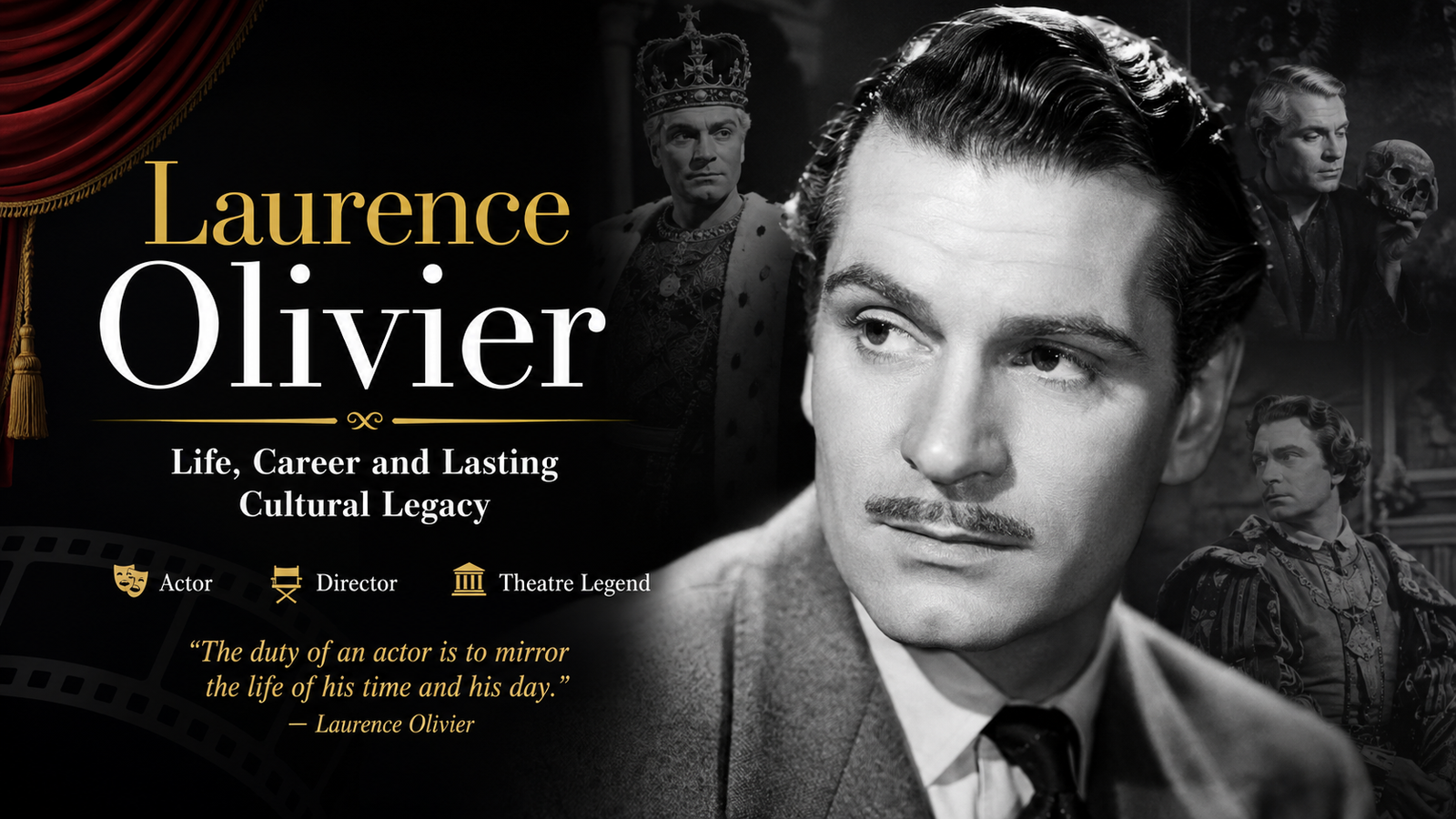
Laurence Olivier was an English actor, director and theatre producer who became one of the defining performers of the twentieth century. He earned worldwide recognition for his work in Shakespearean theatre, classical drama and major motion pictures.
His career lasted for decades and covered an unusually wide range of roles. Olivier could play heroic kings, troubled lovers, intimidating villains and complex historical figures. He was admired for his technical skill, distinctive voice and willingness to transform himself physically and emotionally for a role.
He was also important beyond his own performances. Olivier helped raise the international profile of British theatre and became closely associated with the development of the National Theatre in London.
Why is Laurence Olivier so famous?
Laurence Olivier is famous for several major achievements:
- His influential performances in Shakespearean roles
- His success in both theatre and film
- His work as a film director
- His Academy Award-winning career
- His leadership in British theatre
- His role in establishing the National Theatre as a major cultural institution
- His influence on generations of actors
His reputation was built not on one famous role but on a long career of artistic achievement.
Early Life and Education
Laurence Olivier was born in England in 1907. He grew up in a family environment where education and discipline played an important role, but he developed an early interest in performance.
As a young man, Olivier began to explore acting seriously. He received training that helped him develop the technical foundations that would later become central to his career. Voice control, movement, timing and stage presence all became important parts of his craft.
An early passion for performance
Like many aspiring actors, Olivier’s path to success was gradual. He did not become an international star overnight.
His early experiences taught him important lessons about:
- Working with different types of material
- Adapting to the demands of live theatre
- Understanding an audience
- Developing a strong and controlled voice
- Building believable characters
- Working as part of an ensemble
These foundations helped him handle the demanding roles that later defined his career.
How Did Laurence Olivier Begin His Acting Career?
Laurence Olivier began building his professional reputation through theatre. The stage gave him the opportunity to develop as a performer and work with experienced actors and directors.
British theatre during this period offered Olivier access to a rich tradition of classical and contemporary drama. He gradually gained attention for his ability to bring energy and intelligence to his performances.
His rise was supported by his willingness to work hard and take artistic risks.
Building a professional reputation
An actor’s early career often depends on more than natural talent. Olivier demonstrated the importance of preparation and persistence.
His professional development can be understood as a combination of:
- Formal and practical training
- Stage experience
- Exposure to challenging dramatic roles
- Collaboration with respected theatre professionals
- A constant desire to improve
This approach eventually helped him move from promising young actor to major theatrical figure.
Laurence Olivier and Shakespeare
No discussion of Laurence Olivier is complete without examining his relationship with William Shakespeare.
Olivier became internationally associated with Shakespearean performance. He brought intensity, physical energy and cinematic imagination to characters that many people knew primarily from books or traditional stage productions.
His Shakespearean work helped make classic plays accessible to broader audiences.
Henry V
Olivier’s interpretation of Henry V became one of the defining Shakespearean achievements of his career.
The story of a young king leading England into battle allowed Olivier to combine heroism with emotional complexity. His adaptation also demonstrated how cinema could be used to present Shakespeare in a visually ambitious way.
Hamlet
His portrayal of Hamlet remains one of his most celebrated achievements.
The character is difficult because Hamlet is intellectually complex, emotionally conflicted and constantly questioning the world around him. Olivier approached the role with psychological depth and helped present the prince as a deeply personal and troubled figure.
Richard III
In Richard III, Olivier showed a completely different side of his acting ability.
The character is manipulative, ambitious and dangerous. Olivier transformed himself physically and vocally, creating a memorable villain whose personality was as important as his appearance.
Why were Olivier’s Shakespeare performances important?
His Shakespearean work mattered because it demonstrated that classic drama could be adapted for modern audiences without losing its complexity.
His productions often focused on:
- Clear storytelling
- Strong visual imagery
- Psychological characterisation
- Dynamic performances
- Cinematic movement
- Accessible dramatic tension
For many viewers, his films became an introduction to Shakespeare.
His Rise as a Film Star
Although theatre was central to his identity, Laurence Olivier also became a major film star.
The transition between stage and screen is not always easy. Theatre requires performers to project their voices and physical movements across a large space, while film can capture small expressions and subtle gestures.
Olivier understood the differences between the two mediums and developed a screen presence that appealed to international audiences.
A career beyond Shakespeare
His film career included historical dramas, literary adaptations and character-driven stories. He was able to bring theatrical discipline to the screen while adapting his performances to the camera.
This flexibility was one of his greatest strengths.
He did not simply repeat the same style in every role. Instead, he altered his voice, movement, appearance and mannerisms to suit the character.
The Most Important Films of Laurence Olivier
Laurence Olivier appeared in many important films during his career. Some remain particularly significant because of their artistic ambition or cultural influence.
| Film | Why It Matters |
|---|---|
| Wuthering Heights | Helped establish Olivier as a major international film actor |
| Rebecca | Demonstrated his ability to perform in a psychologically complex drama |
| Henry V | A landmark Shakespeare adaptation and major directing achievement |
| Hamlet | One of his most famous screen performances and directing projects |
| Richard III | A visually memorable and highly influential Shakespeare adaptation |
| Spartacus | Showed Olivier’s ability to portray a powerful and intimidating antagonist |
| Marathon Man | Introduced his dramatic presence to another generation of film audiences |
What can modern actors learn from these performances?
A useful lesson from Olivier’s career is the importance of character transformation.
Rather than relying entirely on a familiar public personality, he often created distinctive characters through details such as:
- Posture
- Facial expression
- Voice
- Accent
- Costume
- Physical movement
- Rhythm of speech
Modern actors continue to use similar techniques when developing demanding roles.
Laurence Olivier as a Director
Laurence Olivier was not only a performer. He also demonstrated significant ability as a director.
Directing allowed him to think about storytelling from a wider perspective. He had to consider camera placement, visual design, pacing and the overall interpretation of a dramatic work.
His experience as an actor gave him a valuable understanding of performance, while his work behind the camera expanded his creative influence.
Bringing theatre to cinema
One of Olivier’s most important contributions was his effort to adapt theatrical works for film in ways that took advantage of cinema.
A straightforward recording of a stage performance can feel static. Olivier recognised that film offered different possibilities.
He used cinematic techniques to create:
- Large-scale historical settings
- Close psychological moments
- Movement between locations
- Dramatic visual compositions
- A stronger sense of spectacle
His approach helped establish new possibilities for Shakespeare on screen.
Theatre Leadership and the National Theatre
Laurence Olivier’s cultural importance extended beyond individual performances and films.
He played a major role in British theatre leadership and became closely associated with the creation and development of the National Theatre.
This part of his career showed that he cared about the future of theatre as an institution.
Why was the National Theatre important?
A national theatre can help support ambitious productions, develop artistic talent and give audiences access to important dramatic works.
The vision behind such an institution goes beyond one actor or one production. It involves building a lasting cultural organisation.
Olivier’s leadership helped establish a foundation for future generations of actors, directors and theatre professionals.
A legacy of institution-building
This is an important part of understanding Laurence Olivier’s influence.
His legacy includes not only:
- Films
- Stage performances
- Awards
- Famous characters
It also includes cultural institutions and artistic opportunities that continued after his career.
Personal Life and Relationships
The personal life of Laurence Olivier attracted significant public attention, particularly because of his high-profile relationships.
His marriages and personal relationships became part of the wider public story surrounding his career. However, his professional life remained remarkably active despite the pressures and changes he experienced privately.
Like many major public figures, Olivier’s life outside the theatre was more complicated than the polished image associated with his greatest performances.
Balancing public and private life
Olivier’s story provides a reminder that artistic success does not necessarily make personal life simple.
Public figures can be celebrated for their work while still facing:
- Relationship difficulties
- Professional pressure
- Public scrutiny
- Personal change
- The challenges of ageing
Looking at both his professional and personal life provides a more complete picture of the man behind the famous name.
Awards and Major Achievements
Laurence Olivier received extraordinary recognition during his lifetime.
His awards reflected the respect he earned across theatre and film. He was honoured for his acting and broader contributions to the performing arts.
Major areas of recognition
His achievements included recognition for:
- Film acting
- Shakespearean performance
- Directing
- Theatre leadership
- Lifetime contributions to the arts
His name also became associated with major honours in British theatre, demonstrating the lasting respect attached to his career.
Why do awards matter in Olivier’s case?
Awards alone do not define artistic greatness. However, in Olivier’s case, they provide evidence of the extraordinary consistency and range of his career.
He earned recognition across different stages of his professional life rather than being remembered for a brief period of popularity.
What Made Laurence Olivier Such a Remarkable Actor?
The greatness of Laurence Olivier came from a combination of talent, technique and ambition.
1. He transformed for his roles
Olivier was known for changing his appearance and mannerisms when necessary.
He understood that physical details could communicate character before a line of dialogue was spoken.
2. He had exceptional vocal control
His voice was one of his most recognisable qualities.
He could use volume, rhythm and emphasis to create authority, tension or vulnerability.
3. He understood classical language
Shakespearean dialogue can be challenging for performers and audiences. Olivier worked to make complex language feel dramatic and purposeful.
4. He combined intellect with emotion
His performances were carefully constructed, but they rarely felt purely mechanical.
He combined technical control with emotional intensity.
5. He was willing to take creative risks
Olivier did not limit himself to safe or familiar roles.
He explored heroes, villains, historical figures and psychologically complex characters.
His Influence on Modern Acting
The influence of Laurence Olivier can still be seen in contemporary theatre and cinema.
Many modern actors study his performances to understand:
- Classical acting technique
- Voice control
- Character transformation
- Shakespearean interpretation
- Screen adaptation
- The relationship between theatre and film
Olivier and method acting
Olivier is sometimes discussed in contrast with actors associated with more naturalistic or method-based approaches.
However, this comparison can oversimplify his work.
Olivier’s approach was strongly shaped by technique and external transformation, but he was also capable of deep emotional expression. His career shows that there is no single formula for great acting.
Different performers can reach powerful results through different methods.
The Lasting Cultural Legacy of Laurence Olivier
The cultural legacy of Laurence Olivier remains strong because his influence exists across several areas of the performing arts.
His legacy in theatre
Olivier remains an important symbol of classical British acting.
His work continues to encourage actors to approach difficult material with discipline and imagination.
His legacy in film
His Shakespeare adaptations demonstrated that classic literature could succeed as ambitious cinema.
Filmmakers continue to adapt Shakespeare, historical drama and classic literature for modern audiences, following paths that Olivier helped develop.
His legacy in cultural institutions
His association with the National Theatre is a reminder that artists can influence culture by building institutions as well as creating individual works.
His legacy for audiences
Perhaps most importantly, Olivier helped bring major dramatic works to audiences who might never have experienced them in a traditional theatre.
Film allowed his interpretations to travel across countries and generations.
Interesting Facts About Laurence Olivier
Here are a few interesting aspects of his remarkable career:
- He worked successfully as an actor in both theatre and cinema.
- Shakespeare played a central role in his artistic reputation.
- He directed major film adaptations as well as starring in them.
- His career covered several generations of British entertainment.
- He was known for transforming his physical appearance for certain roles.
- His name became permanently associated with major achievements in British theatre.
- He remained a prominent performer for much of his life.
What Can We Learn From Laurence Olivier’s Career?
The career of Laurence Olivier offers useful lessons for actors, filmmakers and creative professionals.
Build strong technical skills
Talent becomes more valuable when supported by discipline.
Voice training, movement, preparation and close reading of material all contributed to Olivier’s success.
Keep learning across different mediums
Olivier worked in theatre and film and also developed skills as a director and cultural leader.
His example shows the value of expanding professional abilities.
Respect the audience
Even when working with difficult material, Olivier understood the importance of clear storytelling.
A performance can be intellectually ambitious while still engaging the audience.
Think beyond individual success
His involvement in theatre institutions demonstrates the importance of contributing to a wider creative community.
A lasting career can involve helping create opportunities for others.
Conclusion
Laurence Olivier was far more than a celebrated actor. He was a performer, director, producer and cultural leader whose work helped shape twentieth-century theatre and cinema.
His interpretations of Shakespeare remain central to his reputation, but his achievements extended well beyond classical drama. He proved himself capable of succeeding in film, transforming complex characters and bringing ambitious productions to international audiences.
The lasting importance of Laurence Olivier lies partly in his extraordinary talent and partly in the range of his influence. He helped demonstrate the artistic possibilities of Shakespeare on screen, contributed to the growth of major theatre institutions and set a high standard for technical skill and professional ambition.
For modern audiences, his work offers an opportunity to explore a defining period in the history of British performance. For actors and filmmakers, his career remains a powerful example of preparation, versatility and creative courage.
More than a century after his birth, Laurence Olivier continues to occupy a unique place in cultural history.