

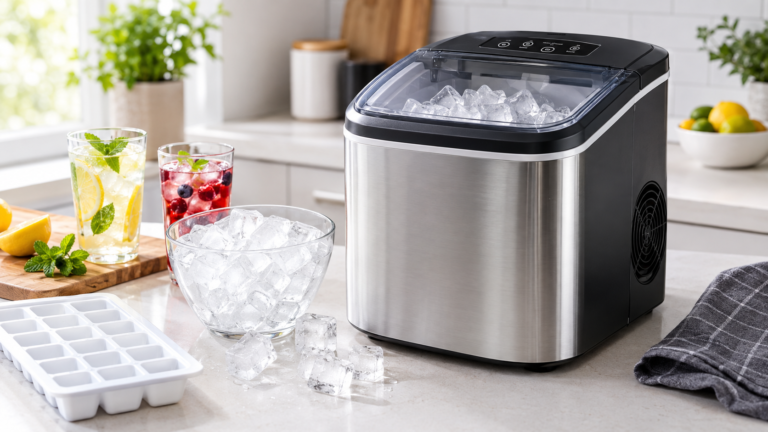



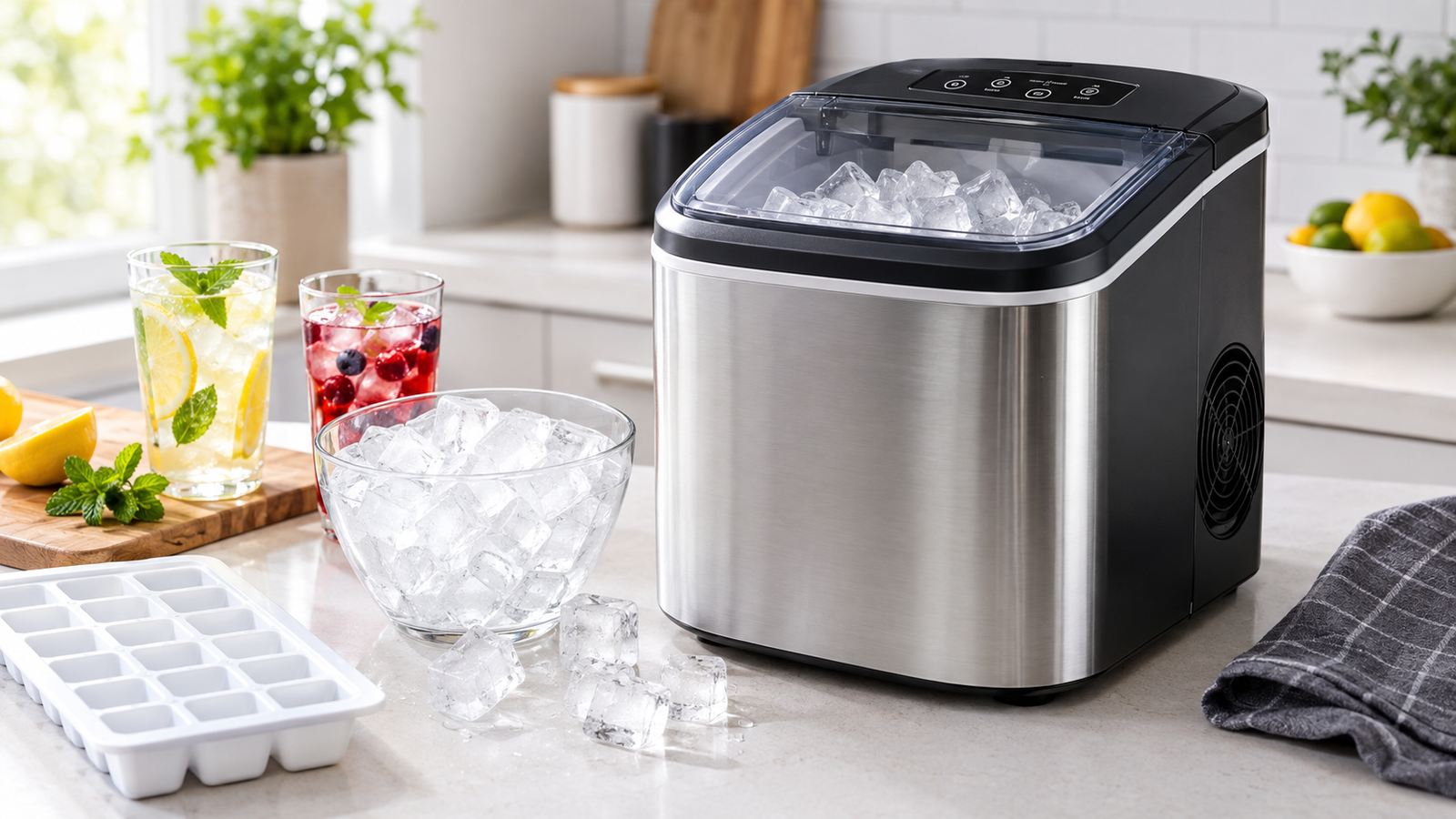
An ice cube maker can be a practical addition to a UK kitchen if you regularly need more ice than a standard freezer tray can provide. Instead of filling an ice cube maker tray and waiting for hours, an electric countertop machine can produce fresh ice in a relatively short time.
Modern ice cube maker machines vary considerably. Some are small enough for a compact kitchen, while others are designed to produce larger quantities for parties, entertaining or regular use. Features can include different cube sizes, automatic shut-off, water-level indicators, viewing windows and self-cleaning programmes.
For example, current UK retailers list countertop models capable of producing ice in roughly six to ten minutes, while daily production capacities vary significantly between machines. Currys currently lists models ranging from compact machines to units advertised at up to 15kg of ice per 24 hours.
What Is an Ice Cube Maker?
An ice cube maker is a small appliance designed to produce ice without relying on traditional freezer trays.
Most countertop models have a water reservoir. You fill the tank, switch the machine on and select the available ice setting. The machine cools the water until ice forms, then transfers the finished pieces into an internal basket.
Unlike a conventional ice cube maker for freezer, a countertop electric model does not require you to freeze a tray inside your freezer. It has its own refrigeration system and is designed to make ice on demand.
This makes an ice cube maker electric appliance particularly useful when:
- You need ice quickly.
- Your freezer has limited space.
- You regularly entertain guests.
- You make iced coffee, soft drinks or cocktails.
- You want a convenient alternative to buying bags of ice.
- You need extra ice during barbecues or summer gatherings.
Argos describes an ice maker as an appliance for producing ice for drinks, entertaining, picnics and coolers, with factors such as ice type, capacity, cycle time, cleaning and ventilation worth considering before buying.
How Does an Ice Cube Maker Machine Work?
The basic process is straightforward.
- Fill the water reservoir with suitable drinking water.
- Switch on the machine and choose the available ice size.
- The cooling system freezes water around the internal ice-making mechanism.
- Ice forms into the machine’s particular shape.
- The finished ice is released into the storage basket.
- The cycle repeats until the water runs low or the ice basket becomes full.
Many countertop models are designed for relatively fast production. For instance, the Salter EK6760 listed by Currys makes eight cubes in about 8.5 minutes and has an 800ml refillable water tank.
Other machines offer larger reservoirs and higher daily output. Argos currently lists a Cooks Professional model with a 2.2-litre water container and claimed output of up to 14kg per 24 hours.
Actual performance can vary according to the machine, room temperature, water temperature, selected ice size and how continuously it is operated.
Ice Cube Maker vs Ice Cube Maker Tray
A traditional freezer tray remains the cheapest and simplest way to make ice, but an electric machine offers a different experience.
| Feature | Ice Cube Tray | Electric Ice Cube Maker |
|---|---|---|
| Power required | No | Yes |
| Uses freezer space | Yes | No dedicated freezer space |
| Production speed | Usually several hours | Often minutes per cycle |
| Capacity | Small batch | Continuous production |
| Portability | Very easy | Depends on machine |
| Controls | None | Usually electronic or button controls |
| Cleaning | Simple | Requires regular machine cleaning |
| Initial cost | Very low | Higher |
A tray makes sense if you only need a few cubes occasionally. An ice cube maker becomes more useful when speed and continuous production matter more.
What to Look for When Buying an Ice Cube Maker UK
Choosing the right machine is less about finding the machine with the biggest advertised output and more about matching its features to how you actually use ice.
1. Water Tank Capacity
Check how much water the machine holds.
A compact ice cube maker may have a relatively small tank, making it suitable for occasional drinks. Larger tanks can reduce how frequently you need to refill the machine.
Remember that water capacity and ice storage capacity are not necessarily the same thing. A machine can have a sizeable water tank but a comparatively smaller ice basket.
2. Ice Production Rate
Look at both the cycle time and the stated daily production.
A machine might make its first batch quickly but have a lower total output than a larger model. If you’re buying an ice maker for parties, consider how much ice you actually need over several hours rather than focusing only on the first batch.
Current UK models illustrate the range. Currys lists machines advertised at around 7.7kg, 12kg and 15kg of ice per 24 hours, depending on the model.
3. Ice Size Options
Some machines make only one type of ice, while others offer two sizes.
Two-size machines can be useful because smaller pieces may suit everyday drinks, while larger pieces can be preferable for certain cocktails or serving situations.
For example, several machines currently listed by Currys offer two cube-size options.
4. Countertop Size
An ice cube maker countertop appliance needs enough room around it for safe operation and ventilation.
Measure your available worktop before buying. Don’t just check width and depth; consider height, cable placement and the space required to open the lid.
For example, the Salter EK6760 measures approximately 18.5cm wide, 27.4cm deep and 30.2cm high.
5. Noise
An ice maker isn’t normally silent because it uses a cooling system and mechanical components.
If you plan to keep it in a kitchen, home bar or open-plan living area, look for information about noise levels and customer feedback. Some current models specifically advertise quiet operation.
6. Self-Cleaning
A self-cleaning ice cube maker can make routine maintenance easier, but the feature should not be interpreted as eliminating manual cleaning.
For example, Currys lists several machines with self-cleaning functions.
You should still follow the manufacturer’s cleaning instructions and keep the water-contact surfaces, ice basket and scoop clean.
7. Ice-Full and Low-Water Indicators
These are small features that can make a noticeable difference in everyday use.
An ice-full indicator can stop production when the basket is full, while a low-water warning tells you when the reservoir needs attention. Several current UK models include both types of indicator.
8. Portability
If you want an ice cube maker for barbecues, garden entertaining or occasional events, check its weight and dimensions.
A countertop machine is portable compared with a plumbed-in commercial unit, but it still needs a suitable mains electricity supply and a stable location.
Ice Cube Maker Amazon UK, Argos, Currys and Other Retailers
UK shoppers may encounter ice makers across major retailers and online marketplaces, including Amazon UK, Argos, Currys, AO and supermarket websites.
Rather than choosing a machine purely because it appears under an “ice cube maker best” search, compare the specifications.
Look at:
- Water tank capacity
- Ice production per cycle
- Claimed 24-hour output
- Ice sizes
- Ice basket capacity
- Dimensions
- Weight
- Noise
- Cleaning requirements
- Warranty
- Power consumption
- Return policy
- Availability of replacement parts
Argos currently lists countertop ice makers at different price points, including a Living and Home model at £74 and a Cooks Professional model at £129.99 at the time of research. Retail prices and availability can change, so check the individual product page before purchasing.
Currys also currently lists models from brands including Salter, CASO, DREAME and Morphy Richards.
Searches such as ice cube maker Argos, ice cube maker Currys, ice cube maker AO, ice cube maker Amazon UK, ice cube maker Tesco, ice cube maker Asda, ice cube maker Aldi, ice cube maker B&M and ice cube maker B&Q can help you compare retailer availability, but stock changes frequently.
Do You Need an Ice Cube Maker for a Freezer?
If you mean a traditional ice cube maker for freezer, you are probably looking for an ice tray or reusable mould rather than an electric appliance.
A freezer tray is appropriate if:
- You only need a small amount of ice.
- You have enough freezer space.
- You don’t mind waiting several hours.
- You want the lowest-cost option.
An electric ice maker is more appropriate when you need fresh ice quickly and repeatedly.
The two products solve slightly different problems, so it isn’t simply a question of which one is “better”.
Ice Cube Maker and Storage: What Happens to the Ice?
A countertop machine normally drops finished ice into an internal basket.
This does not necessarily mean the basket functions like a freezer. Many portable countertop machines are designed primarily to make and temporarily hold ice, rather than keep it frozen indefinitely.
As a result, some of the ice can eventually melt. The water may then be available for the machine to reuse, depending on its design.
If you need large quantities of ice for later use, you may want to transfer the finished ice into suitable freezer storage.
An ice cube maker and storage setup therefore needs a little planning: make ice in batches and move surplus ice to the freezer when appropriate.
Can You Use an Ice Maker With a Water Dispenser?
An ice maker and water dispenser can refer to an appliance that combines both functions, commonly found in larger refrigerators or specialist appliances.
A countertop ice cube maker generally works differently. Most compact models have a manual water reservoir that you fill yourself.
If you specifically want both chilled water and automatic ice production, check the product specification carefully rather than assuming an ordinary countertop ice maker includes a water dispenser.
How Much Does an Ice Cube Maker Cost?
The price depends on the size, brand, features and production capacity.
At the time of research, examples listed by UK retailers included:
- Living and Home: £74 at Argos.
- Salter EK6760: £94.99 at Currys.
- CASO IceChef Compact: £99.99 at Currys.
- Cooks Professional: £129.99 at Argos.
- CASO IceChef Pro: £129 at Currys.
- CASO Clear Ice Advanced: £149 at Currys.
- DREAME IB-50 Aura: £179 at Currys.
- Morphy Richards FrostPro: £199 at Currys.
These are examples rather than fixed UK market prices. Promotions, availability and retailer pricing can change.
If you’re searching for an ice cube maker Aldi price, ice cube maker B&M, ice cube maker Costco or another specific retailer, check the current listing rather than relying on an old price comparison.
How to Clean an Ice Cube Maker
Cleaning is one of the most important parts of owning an ice machine because the appliance comes into direct contact with water and ice intended for consumption.
UK local-authority food safety guidance recommends keeping ice-making equipment clean and following the manufacturer’s cleaning instructions. Guidance for food businesses also highlights the importance of clean scoops and hygienic handling of ice.
For a domestic machine, follow the manufacturer’s specific procedure, but the general approach is:
- Switch the machine off and disconnect it if the instructions require this.
- Remove and discard any remaining ice.
- Empty the water reservoir.
- Remove washable components where permitted.
- Clean the water-contact areas according to the manufacturer’s instructions.
- Clean the ice basket and scoop.
- Rinse thoroughly where required.
- Allow components to dry as instructed.
- Reassemble the machine.
- Run the recommended cleaning or rinse cycle before making fresh ice.
Do not assume that a self-cleaning function replaces all manual cleaning. The manufacturer may specify additional maintenance.
For commercial settings, local UK guidance recommends regular cleaning of the ice storage compartment and stresses that ice should be handled with a clean utensil rather than bare hands.
Is an Ice Cube Maker Hygienic?
An ice cube maker can produce hygienic ice when it is correctly maintained and handled.
The important point is that freezing does not make poor hygiene irrelevant. UK food-safety guidance explains that ice can become contaminated and that cleanliness of the machine, utensils and handling practices matters.
For home use:
- Use clean drinking-quality water.
- Keep the machine away from dirt and excessive dust.
- Clean it according to the manufacturer’s instructions.
- Keep the ice scoop clean.
- Avoid touching ice with your hands.
- Don’t put bottles or other objects inside the ice compartment.
- Discard questionable or contaminated ice rather than trying to reuse it.
For businesses, additional food-safety procedures and cleaning schedules may apply.
Common Ice Cube Maker Mistakes
Choosing based only on production speed
A machine that makes its first cubes quickly isn’t automatically suitable for your needs. Check water capacity, basket size and total production as well.
Buying a machine that’s too large
A high-output machine can take unnecessary worktop space if you only make a few drinks a day.
Ignoring ventilation
Don’t squeeze an ice maker into a tight cupboard or against surrounding objects if the manufacturer requires ventilation space.
Treating the ice basket like a freezer
Many countertop machines are designed for production and temporary storage rather than long-term frozen storage.
Neglecting cleaning
Water and ice-contact components still require maintenance. A self-cleaning cycle is useful, but follow the complete cleaning instructions supplied with the appliance.
Comparing only the headline price
A cheaper machine may have a smaller tank, lower output, fewer settings or a shorter warranty. Compare the complete specification before deciding.
Is an Ice Cube Maker Worth Buying?
An ice cube maker can be worthwhile if you regularly run out of ice, have limited freezer space or want ice available quickly.
It may be unnecessary if you only use a few cubes occasionally and already have enough freezer space for conventional trays.
The decision mainly comes down to usage. Someone who makes iced drinks every day has a different requirement from someone who only needs ice when hosting an occasional summer barbecue.
Frequently Asked Questions
How long does an ice cube maker take to make ice?
The time varies by machine and conditions. Some current UK countertop models advertise first batches in around six to ten minutes. For example, Currys lists a CASO IceChef Compact that can produce ice in as little as six minutes, while the Salter EK6760 is specified at about 8.5 minutes for eight cubes.
Does an ice maker need to be connected to a water supply?
Not necessarily. Many compact countertop machines use a refillable water tank. The Argos Cooks Professional model, for example, has a 2.2-litre water container and does not require plumbing installation.
Can you leave an ice maker running?
Whether you should leave a particular machine running depends on its design and the manufacturer’s instructions. Many machines have automatic controls that stop production when the ice basket is full or water is low, but you should still follow the product manual.
Can an ice maker keep ice frozen?
Not necessarily. Many countertop machines are designed to make ice and hold it temporarily rather than provide long-term freezer storage. Check the manufacturer’s specifications if long-term storage is important.
Are electric ice makers noisy?
They can make some operating noise because they contain a cooling system and mechanical components. Noise levels vary between models, so check the manufacturer’s specification and user feedback before buying.
Can I use tap water in an ice cube maker?
If your household tap water is suitable for drinking, it is generally the type of water intended for domestic ice making. Always follow the manufacturer’s instructions regarding water quality and filtration.
What is the difference between an ice maker and an ice machine?
The terms can overlap. A compact ice cube maker machine usually refers to a domestic countertop appliance, while “ice machine” can also describe larger commercial equipment designed for much higher production volumes.
Final Thoughts
The right ice cube maker depends on how much ice you need, how quickly you need it and how much space you have available.
For occasional use, a compact machine with a small reservoir may be enough. If you regularly entertain, look more closely at production capacity, basket size and refill requirements. Features such as two ice sizes, low-water indicators and self-cleaning programmes can add convenience, but they should be weighed against price and maintenance.
When comparing an ice cube maker UK option, don’t focus solely on claims such as “fastest” or “best”. Check the complete specifications, dimensions, cleaning requirements, warranty and current retailer price. A machine that fits your actual routine will usually be more useful than one that simply has the biggest headline specification.
