




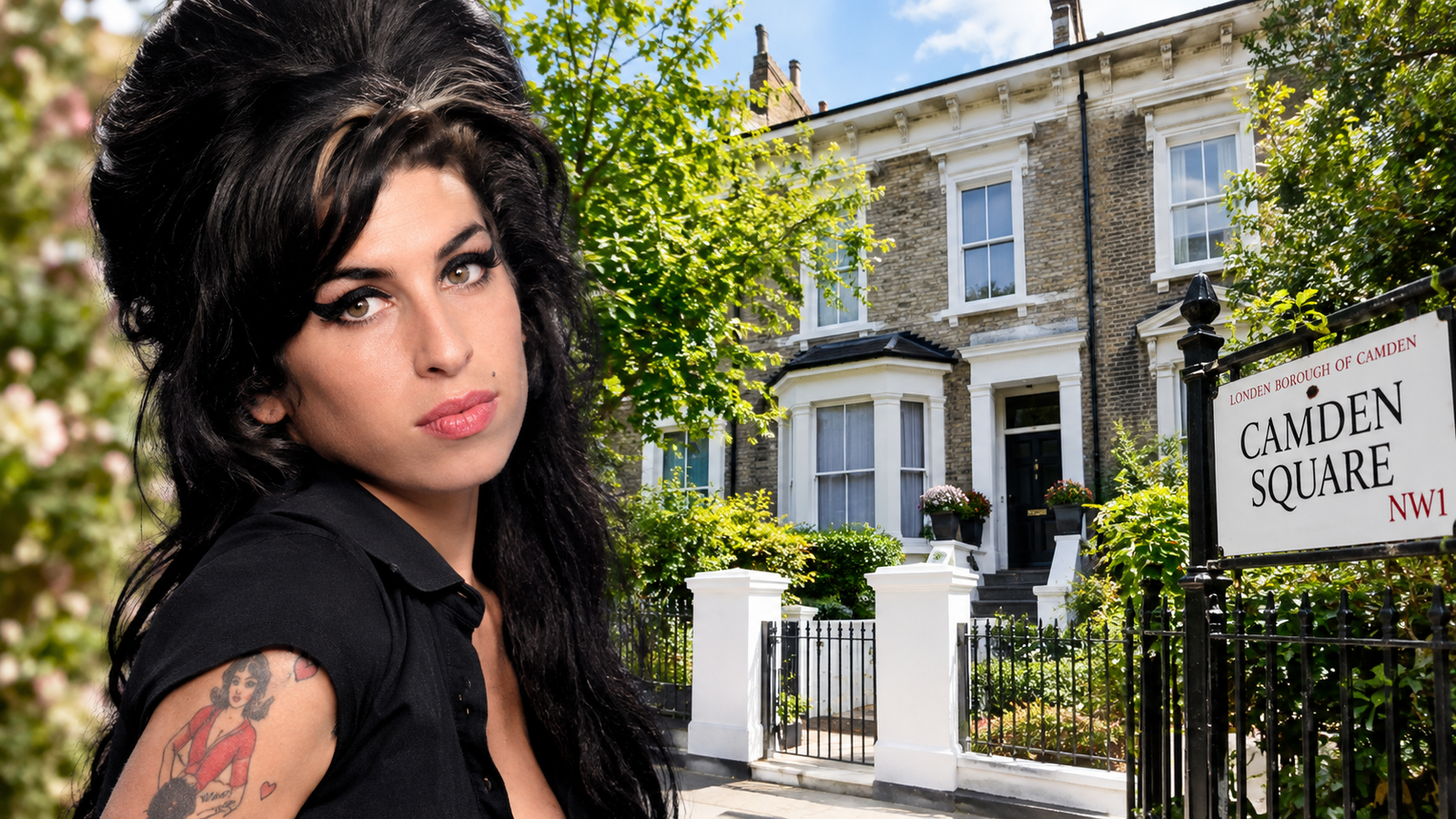
Amy Winehouse’s music is closely associated with London, particularly Camden. Among the places most strongly connected with the singer is her former home on Camden Square, where she lived during the final period of her life.
For fans searching for Amy Winehouse house, the property is more than a London residence. It became part of the story surrounding one of Britain’s most distinctive modern musicians. The house attracted intense public attention after Winehouse’s death in 2011 and was eventually sold at auction.
Here is what is known about the property, its features, its sale and its continuing connection with Amy Winehouse’s legacy.
Where Was Amy Winehouse’s House?
Amy Winehouse’s well-known final home was a period property overlooking Camden Square in north London. She lived there during the months before her death in July 2011.
Camden was particularly significant to Winehouse. The area was not simply where she lived; it was closely connected with her career, friendships and public identity. Her presence became so closely associated with the neighbourhood that Camden is still one of the main places fans associate with her life.
Her former home was a four-storey, semi-detached property of roughly 2,500 square feet. Reports at the time described three large bedrooms, several reception spaces, a dressing room, a gym and a soundproofed music room.
What Was the House Like?
The property was a substantial London family home rather than a purpose-built celebrity residence.
Contemporary property reports highlighted several features:
- Three large bedrooms
- Multiple reception rooms
- A large dressing room with fitted wardrobes
- A gym
- A soundproofed music room
- Private front and rear garden areas
- Security systems
- An electrically operated front gate
The music room is particularly interesting given Winehouse’s career. A dedicated soundproofed space would have made the house more than simply somewhere to live; it also reflected her musical life.
Why Was Amy Winehouse’s House Significant?
The significance of the house comes largely from its connection with the final chapter of Winehouse’s life.
Winehouse died at the Camden property on July 23, 2011, aged 27. Her death brought enormous international attention to the house, and fans began gathering outside the property to leave flowers and tributes.
This created a difficult situation for her family. What had been a private home became a place of public pilgrimage almost overnight.
That distinction matters when discussing celebrity homes. A famous address can become part of public history, but it remains a private residence. In Winehouse’s case, the intense attention eventually influenced the family’s decision to sell the property.
When Was the Amy Winehouse House Sold?
Winehouse’s father, Mitch Winehouse, put the Camden property on the market in 2012.
The family initially marketed it for approximately £2.7 million. However, the sale proved difficult, partly because of the intense public interest surrounding the property. The family eventually decided that an auction would be a more practical way to find a buyer.
In December 2012, the house was sold at auction for approximately £1.98 million after four bidders competed for the property.
The final price was considerably below the original asking figure, illustrating how unusual celebrity property can be. A famous history can attract buyers, but it can also make a home much harder to sell.
Why Did Amy Winehouse’s Family Sell the Property?
The decision was not simply a conventional property investment choice.
Mitch Winehouse explained that keeping the empty house required security and that the family did not feel able to live there. He also described the property as a home Amy had loved and helped shape.
There was also a practical problem: the house had become a destination for fans.
The family had reportedly considered using the property for the Amy Winehouse Foundation, but the amount of public attention made that idea difficult to pursue.
Selling the property therefore separated the private residence from the growing public memorial surrounding Amy’s life.
Who Bought Amy Winehouse’s Former Home?
The house was purchased by Leslie Balfour-Lynn and her husband, Richard Balfour-Lynn, following the December 2012 auction.
The couple reportedly paid just under £2 million and planned to renovate the property before moving in. They were not especially concerned about the home’s association with Winehouse, viewing its history as part of living in an old London property.
That perspective highlights something unusual about the property. For fans, the house carried enormous emotional significance. For its eventual owners, it was also a substantial home in a desirable part of London.
Amy Winehouse and Camden
To understand why the house remains memorable, it helps to look beyond the property itself.
Camden played a major role in Winehouse’s public identity. She worked around Camden as a teenager and later performed at several of the area’s important music venues. The neighbourhood became strongly associated with her image and musical career.
Her connection with Camden has continued after her death. A bronze statue of Winehouse stands at Camden Market, while local venues and locations connected with her career remain points of interest for fans.
In that sense, her Camden home is only one part of a much larger London story.
Is Amy Winehouse’s House a Public Attraction?
No. The former home should not be treated as a public museum or tourist attraction.
Although fans have historically visited the area and left tributes outside properties associated with Winehouse, the house itself became a private residence after its sale.
That distinction is especially important today. Celebrity history can make an ordinary residential street famous, but visitors should respect residents, privacy and local rules.
If you want to explore Amy Winehouse’s London connection, public places such as Camden Market and established cultural venues are more appropriate destinations than attempting to approach a private home.
What Happened to the House After the Sale?
The property moved back into private ownership after the 2012 auction.
This means there is a limit to what can responsibly be said about its current interior, occupants or condition. Older photographs and property descriptions can document what the home looked like when it was sold, but they should not be treated as evidence of its present-day appearance.
That is an important distinction for anyone researching celebrity real estate. A property may remain famous online long after its interior, ownership and use have changed.
Amy Winehouse’s House and Her Legacy
The lasting fascination with the house is understandable, but Amy Winehouse’s legacy extends far beyond a single address.
Her albums Frank and Back to Black established her as one of the defining British singer-songwriters of her generation. Her distinctive voice, jazz influences and deeply personal songwriting helped create a musical identity that remains recognisable years after her death.
Her family also established the Amy Winehouse Foundation, which works with young people and focuses on issues including substance misuse and recovery. The foundation’s work has become an important part of how Winehouse’s legacy continues.
The house, therefore, is best understood as one physical location within a much broader story.
Common Misconceptions About Amy Winehouse’s House
Was the house turned into an Amy Winehouse museum?
No. The Camden property was sold into private ownership rather than becoming a permanent Amy Winehouse museum.
Can fans visit the inside?
There is no general public access to the private residence. Visitors should not attempt to enter or disturb current occupants.
Did Amy own the house herself?
Contemporary reporting said Mitch Winehouse bought the property with Amy in 2010.
Was the property always expensive?
The house was marketed at £2.7 million in 2012 but eventually sold at auction for £1.98 million.
What Can Visitors See in Camden Today?
Fans interested in Amy Winehouse can explore parts of Camden connected with her public life without visiting private residences.
Camden Market is particularly relevant because Winehouse worked there as a teenager, and a statue commemorating her stands at the market. Other locations associated with her include venues such as KOKO, the Jazz Cafe and the Roundhouse.
These public locations provide a better way to understand Winehouse’s relationship with Camden while respecting the privacy of residential properties.
Final Thoughts
The story of Amy Winehouse house is ultimately a story about the boundary between celebrity history and private life.
Her Camden Square home became famous because it was closely tied to the final period of her life. After her death, it became a place where fans gathered, creating challenges for her family and eventually contributing to the decision to sell. The property was auctioned in 2012 for £1.98 million and subsequently returned to private life.
Today, Camden remains one of the best places to understand Winehouse’s London story. But her lasting legacy is found less in a particular house than in her recordings, influence and the charitable work carried forward in her name.